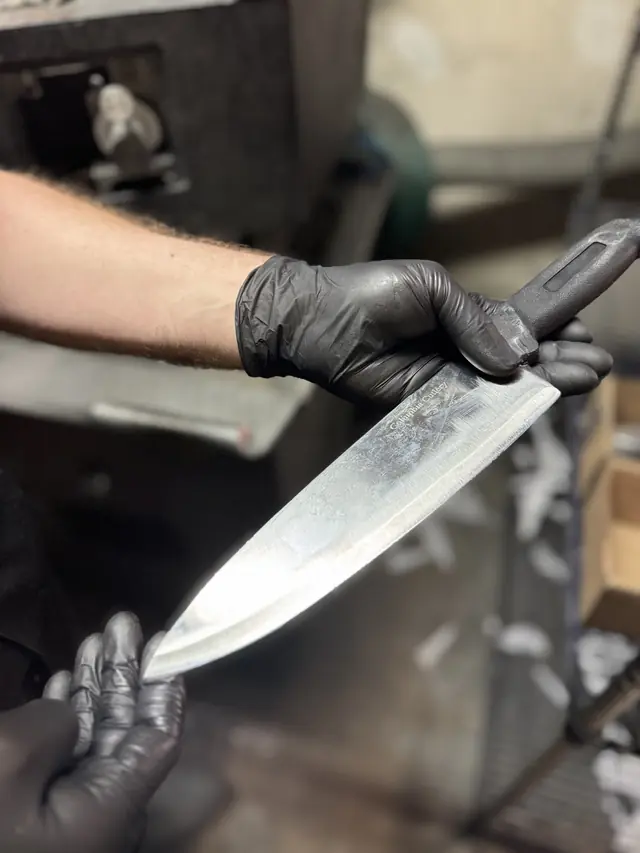
Most "dull" knives aren't dull yet. The edge has just rolled over to one side. A few passes on a honing steel stands it back up. When honing stops working, it's time to sharpen.
Honing vs. sharpening, in one line each
- Honing straightens the edge you already have. No metal comes off. Do it often.
- Sharpening grinds a new edge. Metal comes off. Do it when honing stops helping.
How to hone, step by step
- Hold the steel straight up and down, tip resting on a towel on the cutting board.
- Set the angle. Tilt the blade about 15–20 degrees off the steel. For reference, 90 degrees is straight out, half that is 45, and half again is about 22.
- Pull down and back. Draw the knife down the steel from heel to tip in one smooth stroke, with light pressure. Let the knife's weight do the work.
- Switch sides. Do the same stroke on the other side of the steel.
- Repeat 4–6 times per side, then test on a tomato or a sheet of paper.
Go slow and light. Speed and force are how knives get chipped and hands get cut.
How often to hone
| Kitchen | Hone | Sharpen |
|---|---|---|
| Restaurant line | Every shift, often several times | Every week |
| Busy home cook | Every few uses | Every 3–6 months |
| Occasional home cook | Before you cook | Once or twice a year |
Signs it's time to sharpen instead
- Honing helps for a minute, then the knife is dull again
- It slides off a tomato skin or onion
- You can see shiny, flat spots on the edge when you look straight down at it
- There are chips or a broken tip
A few don'ts
- Don't hone serrated knives on a regular steel.
- Don't use a pull-through gadget on a good knife. They chew up the edge.
- Don't put knives in the dishwasher. The heat and rattling dull them fast.
When you need a real sharpening
Drop off at our Flower Mound shop for $8 a knife (in by noon, usually ready the same day), or book an at-home visit. Restaurants: our weekly routes keep your line sharp without anyone touching a steel.